Close Cookie Notice

Welcome to the MIT CISR website!

This site uses cookies. Review our Privacy Statement.

Red briefing graphic
Research Briefing

Enterprise IT Operating Models in the AI Era

In this briefing, we examine the pressures on enterprise IT operating models and propose a framework to help enterprise leaders make strategic choices.
Abstract

Newer digital technologies such as artificial intelligence are blurring the lines between the IT function and business units, offering new approaches to the enterprise IT operating model. As part of these approaches, many top performers are increasing both speed and scale, relying on modularity and reuse architected by strong IT leadership. In this briefing, we examine the pressures on enterprise IT operating models and propose a framework to help enterprise leaders make strategic choices. We also examine the differences in platform use and innovation among the models.

Access More Research!

Any visitor to the website can read many MIT CISR Research Briefings in the webpage. But site users who have signed up on the site and are logged in can download all available briefings, plus get access to additional content. Even more content is available to members of MIT CISR member organizations.

Author Alan Thorogood reads this research briefing as part of our audio edition of the series. Follow the series on SoundCloud.

DOWNLOAD THE TRANSCRIPT

We are in an era of unprecedented technological change and volatility. And with that volatility comes bold pronouncements about enterprise information technology (IT): This is the end of the IT function. We need to democratize development. AI will replace everything. Cyber is the biggest threat to the enterprise. 

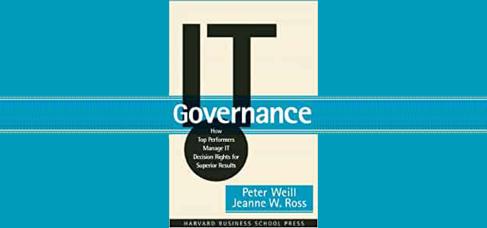
For more than fifty years, MIT CISR has researched how to organize technology in the enterprise. Peter Weill and Jeanne Ross studied IT decision rights and accountability, publishing insights in the book IT Governance[foot]Peter Weill and Jeanne W. Ross, IT Governance: How Top Performers Manage IT Decision Rights for Superior Results (Boston: Harvard Business Review Press, 2004).[/foot] in 2004. Newer digital technologies such as artificial intelligence are blurring the lines between the IT function and business units, offering new approaches to the IT operating model. As part of these approaches, many top performers are increasing both speed and scale, relying on modularity and reuse architected by strong IT leadership. 

In this briefing,[foot]Thank you to Peter Weill, Nick van der Meulen, and Ina Sebastian for their help in refining the text of this briefing and naming the dimensions and quadrants of the model.[/foot] we examine the pressures on enterprise IT operating models and propose a framework to help enterprise leaders make strategic choices. We also examine the differences in platform use and innovation among the models.

The Enterprise IT Operating Model 

An enterprise IT operating model describes the ways the enterprise organizes to create value from IT—the accountabilities, processes, platforms, metrics, and behaviors. The model describes the roles of the IT unit and the business units and how they collaborate. An effective enterprise IT operating model in the AI era enables the enterprise’s most valuable components and capabilities to innovate and grow, and scales the use and reuse of data and AI. It also manages risks such as cyber threats, privacy breaches, supplier demands, and competitive threats from new business models. A great operating model ensures continuous value creation and helps build a digitally savvy workforce for the future. 

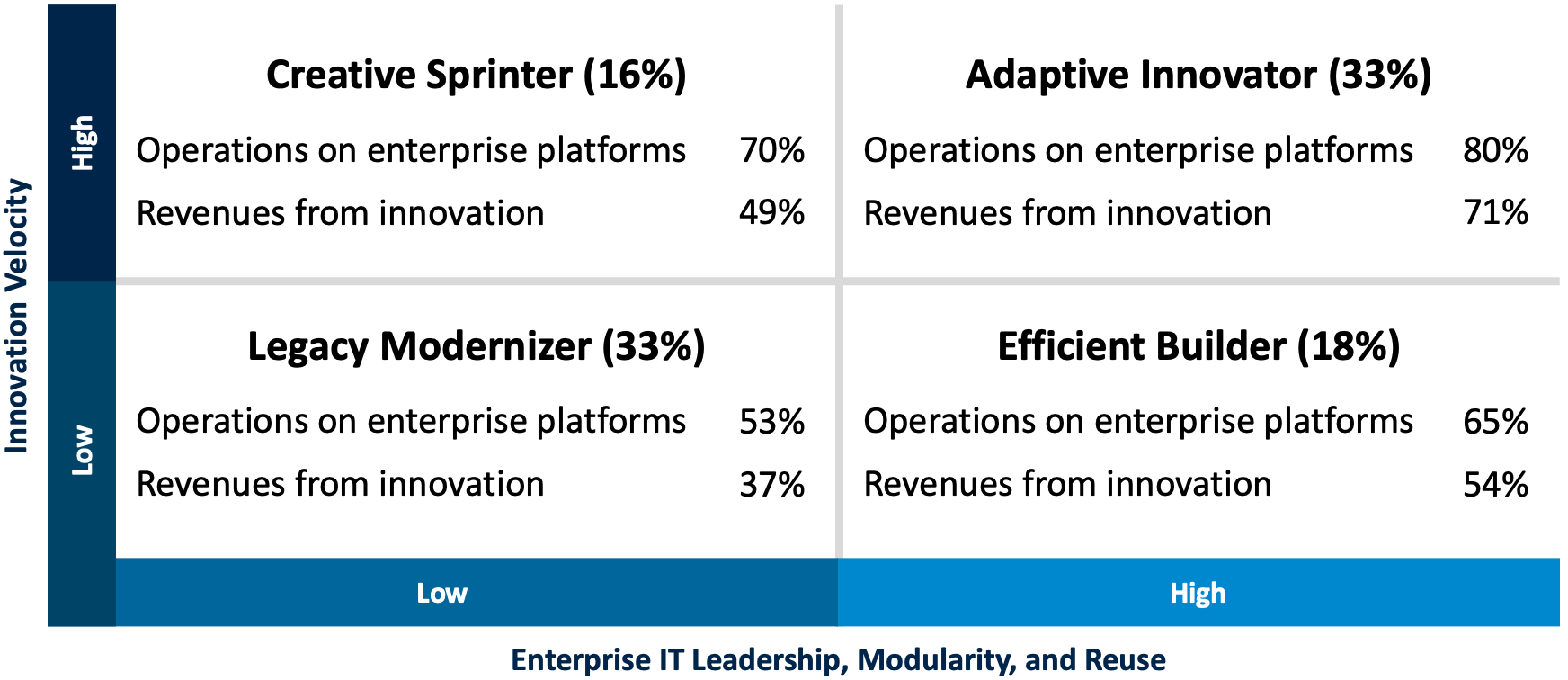
We identified two dimensions of an enterprise IT operating model (see the figure).[foot]We derived dimensions of the 2x2 model from analysis of 39 interviews conducted in 2024 and 2025 with 30 companies. We conducted summarization and synthesis analyses of transcripts of the interviews using a secure MIT instance of OpenAI’s GPT-5 model, asking for two dimensions underlying the impetus for change. Using data from the MIT CISR 2025 Real-Time Business Survey (N=152), we identified variables that represented facets of the two dimensions. Percentages of enterprises in each quadrant came from the same survey and represent the dominant enterprise IT model. We developed case vignettes using interview data, public data, and researcher interpretation.[/foot] The horizontal dimension—Enterprise IT Leadership, Modularity, and Reuse—captures the enterprise effectiveness of use of digital, data, and technology; leadership can be at the enterprise or business unit level or both. Being low on this dimension reflects local decision-making with little reuse of technology, data, and lessons learned. Being high on this dimension reflects strong enterprise IT leadership; the creation of reusable platforms, modules, and data; and the right balance of local and enterprise-wide capabilities. 

The vertical dimension—Innovation Velocity—represents the impacts from current challenges to resilience, decision-making speed, and the enterprise’s emphasis on innovation, and reflects the speed of change in the business environment (largely driven by the threats and opportunities from AI).[foot]For more information on the increasing speed of change, see Charles H. Fine, Clockspeed: Winning Industry Control in the Age of Temporary Advantage (New York: Basic Books, 1998).[/foot] Enterprises with relatively more stable business environments need less innovation velocity. They can use multiyear planning to incrementally improve the enterprise through steady innovation and cost reduction. Enterprises responding to rapidly changing environments require fast-changing business models with higher innovation velocity, shorter planning cycles, and more of their people focused on innovation. 

Combining these two dimensions in a 2x2 model yields four enterprise IT operating models: Legacy Modernizer, Creative Sprinter, Adaptive Innovator, and Efficient Builder. Each model requires different leadership and governance and, on average, delivers different outcomes.

Figure: Enterprise IT Operating Models in the AI Era

Enterprise IT Operating Models in the AI Era

Percentages of enterprises in each quadrant came from the MIT CISR 2025 Real-Time Business Survey and represent the dominant enterprise IT model. “Operations on enterprise platforms” is the percentage of operations relying on those platforms. “Revenues from innovation” is the percentage of revenues from products and services introduced in last three years.

Source: Two dimensions underlying the impetus for change were derived from analysis of 39 interviews with 30 companies conducted in 2024 and 2025. Researchers summarized and synthesized transcripts using a secure MIT instance of OpenAI’s GPT-5 model.  They created the 2x2 using data from the MIT CISR 2025 Real-Time Business Survey (N=152), combining three variables for each axis. The horizontal axis comprises the percentage of shared and standard applications, effectiveness of reuse, and the percentage of IT and digital spending in the IT budget. The vertical axis comprises effectiveness of environmental resilience, effectiveness of decision-making speed, and the percentage of employees with innovation goals. Percentages of enterprises came from the MIT CISR 2025 Real-Time Business Survey and represent the dominant enterprise IT model. 

Legacy Modernizer 

This model represented thirty-three percent of the enterprises in our research. Mature enterprises operating in less fast-changing or lower clockspeed industries, where business units achieve scale benefits on their own and face different technologies or markets with few commonalities, are well-suited to this model. Decision-making is close to the business unit, which retains many technology decision rights, typically driven by local business needs. Enterprise IT provides some governance and shared tools. Significant challenges for the Legacy Modernizer model include updating legacy systems while retaining the skill and discipline to create reusable platforms and not chasing the latest business need. Legacy Modernizers in our research had fifty-three percent of their operations on enterprise platforms and acquired thirty-seven percent of their revenues from innovation.[foot]We measure innovation as the percentage of revenues from products and services introduced in the last three years.[/foot] Enterprise-wide platforms might have capabilities including financial consolidation and closure as well as cybersecurity and identity management. 

One example of an enterprise with the Legacy Modernizer model is a multinational mining enterprise with business units encompassing different technologies, industries, and regions. The variety of markets, ownership structures, and extraction technologies forces each business unit to optimize independently.

Creative Sprinter 

Enterprises that work effectively in this model have business units that drive innovation directly aligned to customer experience and product differentiation. Each of the business units typically has different customers and regulatory environments and operates in fast-changing industries that require high innovation velocity. When this model is working well, business units coordinate and learn from each other’s digital experiences. Enterprise IT acts as an orchestrator, ensuring interoperability and security, but it is not responsible for execution. Sixteen percent of enterprises in our research had this as their dominant model, with seventy percent of operations on enterprise platforms and forty-nine percent of their revenues from innovation. Creative Sprinters share IT capabilities and knowledge with other business units—but the business units typically own product and channel platforms. 

Bupa is an example of a Creative Sprinter, employing dispersed IT operating models across the UK, Asia Pacific, and Europe and Latin America. Each region has its own IT unit that aligns with its market needs and history. The regions use a common set of metrics, board reporting, and strategic alignment. Successful experiments in one business unit can be replicated across the enterprise.

Adaptive Innovator 

Enterprises that effectively use this model operate in fast-changing industries requiring high levels of innovation enabled by strong enterprise IT leadership and platform reuse—both enterprise-wide and locally. Adaptive Innovators federalize technology strategy to enable scalable innovation, leveraging unified data platforms, global digital services, and enterprise-grade AI, but also enabling local business units to drive their own innovation. Enterprise IT ensures governance, security, and interoperability while supporting experimentation through controlled frameworks and helping business units reuse platforms and components (e.g., during customer onboarding) to accelerate innovation. Adaptive Innovators in our research, which represented thirty-three percent of enterprises, relied on enterprise platforms for eighty percent of their operations and received seventy-one percent of their revenues from innovation. 

Heineken, a global brewing company based in the Netherlands, is an example of an Adaptive Innovator. Heineken is modernizing and consolidating its platforms globally. Its digital backbone has three components: a digital core, forty enterprise business platforms that integrate through the core, and an outer digital products layer. Innovation takes place on the enterprise platforms; the outer digital products layer is used for initiatives with economic lifespans of months to several years. The Digital and Technology unit’s strategy empowers business functions to lead technology adoption and experimentation, and then it replicates success internationally.[foot]Based on researcher interpretation of three sources: “Brewing with Artificial Intelligence (AI),” Heineken Newsroom, February 5, 2025, https://www.theheinekencompany.com/newsroom/brewing-with-ai/;  Ronald den Elzen, “What Is Behind Heineken’s Digital Backbone?,” LinkedIn post, March 15, 2025, https://www.linkedin.com/posts/ronald-den-elzen-2b1345_bestconnectedbrewer-digitalbackbone-futureproof-activity-7216771097495560193-PVsH; and Heineken N.V., Annual Report 2024 (February 20, 2025), accessed December 10, 2025, https://www.theheinekencompany.com/sites/heineken-corp/files/2025-02/heineken_n_v_annual_report_2024_final_20feb2025.pdf.[/foot]

Efficient Builder

Enterprises with an Efficient Builder model operate in lower-clockspeed industries, standardizing much of their technology across the enterprise to ensure compliance, reliability, quality, and cost control. Enterprise IT owns the majority (but not all) of the platforms and data architecture, focusing on automation, integration, and risk reduction, driving down not only business process costs but also IT costs. Business units focus on the systems that are truly unique to their needs. Reusing many of the same platforms within and across business units ensures reliability and cost control. The eighteen percent of enterprises in our research that were Efficient Builders relied on platforms for sixty-five percent of operations and acquired fifty-four percent of their revenues from innovation. 

An example of an Efficient Builder, Hunter Water in Australia delivers drinking water, wastewater, recycled water, and some stormwater management services to its customers. Control of both IT and operational costs and quality is a focus for their stakeholders. Except for operational technology, all Hunter Water technology is managed by enterprise IT. The enterprise’s major platforms support billing, field service management, and asset management. Hunter Water is moving toward two-in-a-box platform management, in which the Operations and Customer units plus IT will manage the business processes and data; Finance plus IT will manage cost accounting; and IT will manage the technology platforms.

The Right IT Operating Model for Your Enterprise

The pressures and opportunities enterprises are facing in the AI era require a new, more nuanced approach to structuring the enterprise IT operating model, driven in part by your company’s need for innovation to thrive. The first decision to make is what innovation velocity your enterprise will need. It will be higher if you operate in a faster-changing industry where business models will be threatened or disintermediated by AI (used either by incumbents or new entrants). The second decision is not whether IT should be centralized or decentralized, but how strongly you want to drive IT leadership principles that result in building and reusing platforms and modules. Perhaps the most critical finding of this research is that innovation is more effective with strong IT leadership, resulting in high modularity and reuse regardless of whether those enterprises operate in environments with low or high innovation velocity. What is the right IT operating model for your enterprise, and how will you get there?

© 2025 MIT Center for Information Systems Research, Thorogood and Woerner. MIT CISR Research Briefings are published monthly to update the center’s member organizations on current research projects.

About the Researchers

Profile picture for user alant@mit.edu

Alan Thorogood, Research and Member Engagement, AsiaPac, MIT Center for Information Systems Research (CISR)

E94-15th floor
(617) 253-2348

MIT CENTER FOR INFORMATION SYSTEMS RESEARCH (CISR)

Founded in 1974 and grounded in MIT's tradition of combining academic knowledge and practical purpose, MIT CISR helps executives meet the challenge of leading increasingly digital and data-driven organizations. We work directly with digital leaders, executives, and boards to develop our insights. Our research is funded by member organizations that support our work and participate in our consortium. 

MIT CISR Patrons
AlixPartners
Avanade
Cognizant
Collibra
IFS
MIT CISR Sponsors
ABN Group
Alcon Vision
ANZ Banking Group (Australia)
AustralianSuper
Banco Bradesco S.A. (Brazil)
Banco do Brasil S.A.
Barclays (UK)
BNP Paribas (France)
Bupa
Caterpillar, Inc.
Cemex (Mexico)
Cencora
CIBC (Canada)
Cochlear Limited (Australia)
Commonwealth Superannuation Corp. (Australia)
Cuscal Limited (Australia)
Dawn Foods
DBS Bank Ltd. (Singapore)
Doosan Corporation (Korea)
Ericsson (Sweden)
Fidelity Investments
Fomento Economico Mexicano, S.A.B., de C.V.
Genentech
Gilbane Building Co.
Hunter Water (Australia)
International Motors
Jewelers Mutual
JPMorgan Chase
Kaiser Permanente
Keurig Dr Pepper
King & Wood Mallesons (Australia)
Mater Private Hospital (Ireland)
Nasdaq, Inc.
Nomura Holdings, Inc. (Japan)
Nomura Research Institute, Ltd. Systems Consulting Division (Japan)
Novo Nordisk A/S (Denmark)
OCP Group
Pacific Life Insurance Company
Pentagon Federal Credit Union
Posten Bring AS (Norway)
Principal Life Insurance Company
Ralliant
Reserve Bank of Australia
RTX
Saint-Gobain
Scentre Group Limited (Australia)
Schneider Electric Industries SAS (France)
Tabcorp Holdings (Australia)
Telstra Limited (Australia)
Terumo Corporation (Japan)
Truist Financial Corporation
UniSuper Management Pty Ltd (Australia)
Uniting (Australia)
Vanguard
WestRock Company
Wolters Kluwer Financial & Corporate Compliance
Xenco Medical
Zoetis Services LLC

MIT CISR Associate Members

MIT CISR wishes to thank all of our associate members for their support and contributions.

Find Us
Center for Information Systems Research
Massachusetts Institute of Technology
Sloan School of Management
245 First Street, E94-15th Floor
Cambridge, MA 02142
617-253-2348