

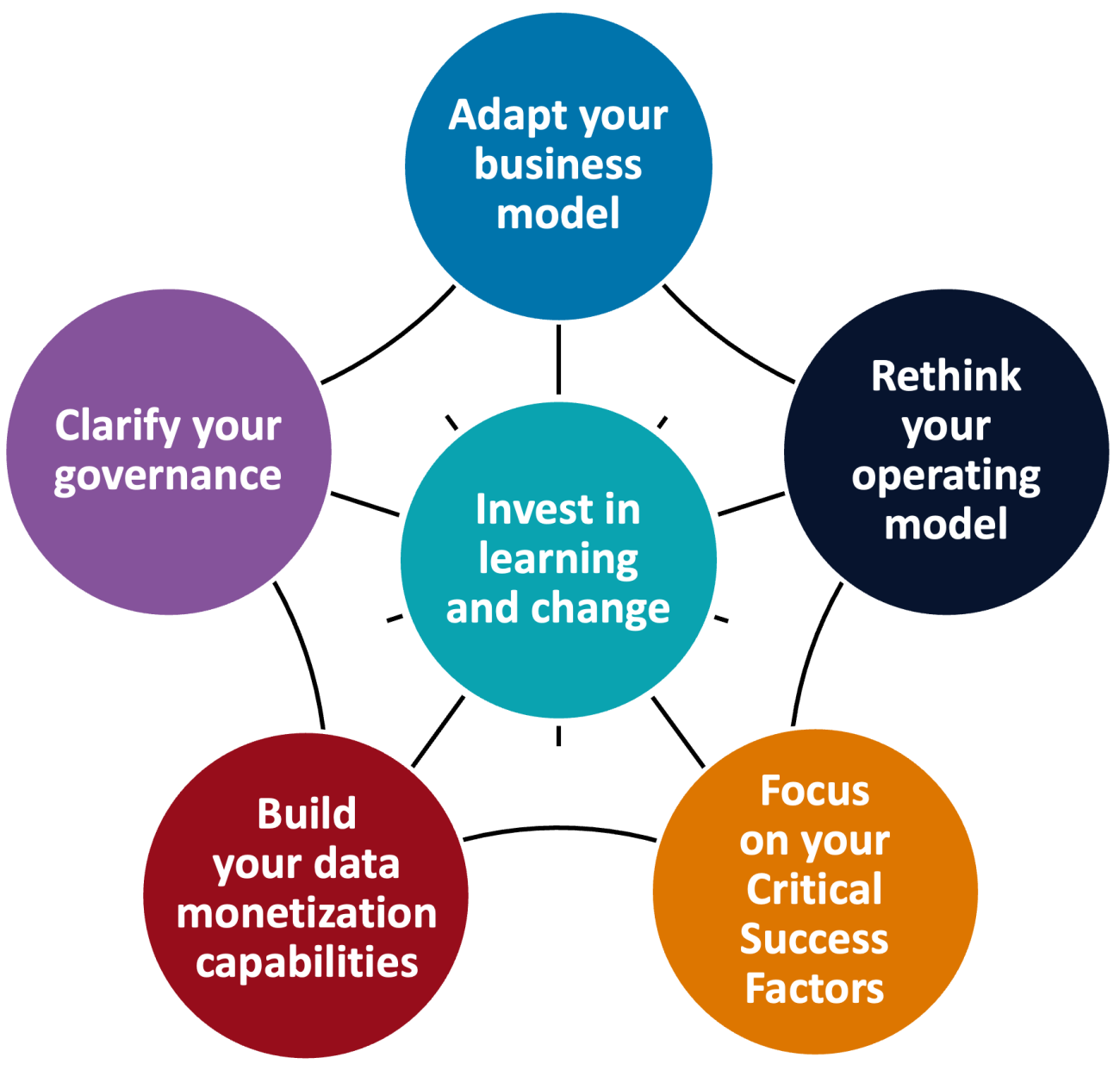
Founded in 1974, the MIT Center for Information Systems Research (CISR) will close on October 31, 2026. Throughout fifty-two years as a practice-oriented research center, MIT CISR has conducted hundreds of projects[foot]The working papers and research briefings MIT CISR has published over its fifty-two years report the findings from the center’s research. MIT CISR has deposited this extensive collection in the MIT Open Scholarship repository (DSpace@MIT) at MIT Libraries. Anyone can access these and other publications at MIT CISR’s permanent address in the repository: https://dspace.mit.edu/handle/1721.1/163647.[/foot] studying how top-performing enterprises generate business value from technology. In this final briefing, we offer six of the center’s most impactful research insights, interdependent and in no prescribed sequence (see the figure), summarizing the takeaways we’ve published and then extrapolating their relevance to 2027.

Enduring Lessons from Fifty-Two Years of MIT CISR Research
Abstract
Founded in 1974, the MIT Center for Information Systems Research (CISR) will cease operations on October 31, 2026. Throughout fifty-two years as a practice-oriented research center, MIT CISR has conducted hundreds of projects studying how top-performing enterprises generate business value from technology. Technologies change, but the essential management practices endure: adapt your business model, rethink your operating model, focus on critical success factors, build data capabilities, clarify governance, and invest in learning and change—and then repeat. In this final briefing, we discuss six of the center’s most impactful research insights, summarizing the takeaways we’ve published and then extrapolating their relevance to 2027.
Figure: The MIT CISR Value Web
Adapt Your Business Model
How an enterprise creates value and makes money is the foundational question of a business; the answer changes as new technologies and capabilities shift what is possible. The cloud, mobile apps, social media, the Internet of Things, and data analytics were all new in the early 2010s; over the next few years, we reported how enterprises were using them to create new value. In a 2015 MIT Sloan Management Review article and our 2018 book What’s Your Digital Business Model?,[foot]Peter Weill and Stephanie L. Woerner, “Thriving in an Increasingly Digital Ecosystem,” MIT Sloan Management Review 56, no. 4 (Summer 2015): 27–34, reprint #56417; and Peter Weill and Stephanie L. Woerner, What’s Your Digital Business Model?: Six Questions to Help You Build the Next-Generation Enterprise (Harvard Business Review Press, 2018).[/foot] we described how these technologies and capabilities were enabling enterprises to learn more about their consumer and business customers, particularly their life events and goals, and to move beyond linear value chains to operate in increasingly digital ecosystems. We called enterprises that did both Ecosystem Drivers. From 2012 to 2025, Ecosystem Drivers outperformed other business-model categories on both industry-adjusted profit margin and revenue growth.
The recent rapid emergence of generative AI, especially large language models and AI agents, is testing enterprises’ ability to adapt their business models. We predict that business models will become increasingly oriented toward customer outcomes, enabled by well-governed agentic AI that can autonomously deliver those outcomes.[foot]P. Weill, I. M. Sebastian, S. L. Woerner, and G. Benedict, “Business Models in the AI Era,” MIT CISR Research Briefing, Vol. XXV, No. 10, October 2025, https://dspace.mit.edu/handle/1721.1/174944.[/foot] We think two shifts are underway in how enterprises create new value: from learning about end customers to taking action on their behalf, and from business design to the execution of those actions. Enterprises will execute actions through either a structured or an adaptive approach. In a structured approach, AI agents will execute predetermined processes, such as customer onboarding in regulated environments. In an adaptive approach, agents will optimize for a desired outcome by identifying the most effective process, such as in the identification of therapeutic molecules for drug discovery. Enterprises will also need to rethink how they operate to make their chosen business models work.
Rethink Your Operating Model
In their 2006 book Enterprise Architecture as Strategy,[foot]Jeanne W. Ross, Peter Weill, and David C. Robertson. Enterprise Architecture as Strategy: Creating a Foundation for Business Execution (Harvard Business School Press, 2006).[/foot] Jeanne Ross, Peter Weill, and David Robertson argued that effective operating models define both process integration—how much data and activity must be shared across business units—and process standardization—how consistent the work across those units must be. By making the choices of integration and standardization explicit, leaders replace a patchwork of local processes with a coherent foundation for execution—clarifying what must be common, what may remain different, and where autonomy creates value rather than complexity.
In the age of agentic AI, this argument is even more important. Every AI agent quietly embeds operating-model decisions of what data it can access, which decisions it can make, which processes it must follow, and whether it learns locally or across the enterprise. Leaders who deploy AI agents before determining where processes and data must be integrated and standardized risk embedding fragmented ways of working in automation—creating more silos, inconsistent decisions, and agents that work at cross-purposes. But implementing agentic AI offers a new opportunity to rethink which workflows should be unified and which insights coordinated, and where diversity must be preserved. Enterprises that make these choices deliberately and secure leadership buy-in can develop the enterprise operating model they have long needed but may never have fully realized—provided they attend to a handful of critical success factors.
Focus on Your Critical Success Factors
Jack Rockart, an MIT CISR cofounder, made a deceptively simple argument in his seminal 1979 Harvard Business Review article “Chief Executives Define Their Own Data Needs.”[foot]J. F. Rockart, “Chief Executives Define Their Own Data Needs,” Harvard Business Review 57, no. 2 (March–April 1979): 81–93.[/foot] Senior leaders were being overwhelmed by the output of information systems that produced mountains of data but too little insight. Rockart proposed reversing the process: Begin by identifying a handful of critical success factors (CSFs)— the conditions or capabilities in which the enterprise must excel to achieve its objectives. Then determine what information would strengthen performance in each area. The enduring power of this approach is its discipline: It connects strategy, managerial attention, and information.
Applied to today, Rockart’s message is provocative. Many enterprises are accumulating AI use cases without deciding where AI could most help drive competitive success. Instead, leaders should identify their CSFs, pinpoint the decisions and workflows that most influence them, and then redesign those activities around the complementary strengths of people and AI. Top performance will come not from the most AI, but from concentrating AI on CSFs and transforming how that work gets done. Whether enterprises can do so will depend on the data they have—and how they manage it.
Build Your Data Monetization Capabilities
How enterprises manage data has been a research topic at MIT CISR since its earliest days. In the 1970s, Stuart Madnick was developing new approaches to database and information-system architecture.[foot]For example, see C. Lam and S. E. Madnick, “Infoplex data base computer architecture: concepts and directions,” MIT CISR Working Paper No. 41, August 1978, http://hdl.handle.net/1721.1/48079.[/foot] Decades later, in the book Data Is Everybody’s Business,[foot] B. H. Wixom, C. M. Beath, and L. Owens, Data Is Everybody’s Business: The Fundamentals of Data Monetization (MIT Press, 2023).[/foot] Barbara Wixom and her co-authors identified three ways to monetize data: improve processes by using data to do things better, cheaper, and faster; wrap analytics around products or services to increase their value to customers; and sell information offerings, such as aggregated insights.
Building on their data monetization research, Wixom and her colleagues argued that enterprises seeking to realize value from AI must manage their data, make it accessible, and equip people across the organization—not only data specialists—to use it effectively.[foot]B. H. Wixom and C. M. Beath, “AI Is Everybody’s Business,” MIT CISR Research Briefing, Vol. XXIV, No. 5, May 2024, https://dspace.mit.edu/handle/1721.1/174857.[/foot] Their data monetization mindset frames AI value creation as a shared enterprise pursuit, supported by governance.
Clarify Your Governance
In 2004 MIS Quarterly Executive and 2005 MIT Sloan Management Review articles and our IT Governance book,[foot]Peter Weill, “Don’t Just Lead, Govern: How Top-Performing Firms Govern IT,” MIS Quarterly Executive 3, no. 1 (2004): 1–17; Peter Weill and Jeanne W. Ross, “A Matrixed Approach to Designing IT Governance,” MIT Sloan Management Review 46, no. 2 (Winter 2005): 26–34; Peter Weill and Jeanne W. Ross, IT Governance: How Top Performers Manage IT Decision Rights for Superior Results (Harvard Business School Press, 2004).[/foot] we argued that effective IT governance begins by making decision rights and accountability explicit. Governance is the disciplined assignment of authority for a small number of critical decisions, clear accountability for their outcomes, and effective mechanisms for translating those decisions into action and measurable business value. The central challenge is to align governance with the enterprise’s strategic needs without creating unnecessary bureaucracy. Effective governance therefore establishes a focused set of principles, decision domains, and accountability mechanisms to guide investments, architecture, applications, and business solutions.
AI raises the stakes. Governance must now encompass AI models, AI agents—including those deployed as digital colleagues—and automated decisions, while maintaining clear human accountability. To govern this expanding landscape without stifling innovation, in a 2026 MIT CISR briefing Nick van der Meulen proposed minimum viable governance: the least governance needed to manage risk effectively while enabling opportunity.[foot]N. van der Meulen, J. Jewer, and N. Levallet, “Minimum Viable Governance for Generative AI,” MIT CISR Research Briefing, Vol. XXVI, No. 3, March 2026, https://dspace.mit.edu/handle/1721.1/174985.[/foot] In practice, that means establishing a small set of non-negotiable decision rights: who may deploy an agent, what data and models it may use, which decisions require human oversight, how performance and bias are monitored, and who is accountable for preventing harm. The aim is governance strong enough to protect enterprise values and public trust, yet light enough to let innovation flourish as employees learn and change.
Invest in Learning and Change
Several of MIT CISR’s key insights have taken the form of maturity frameworks, including the 2006 Enterprise Architecture Maturity Framework[foot]Ross, Weill, and Robertson, Enterprise Architecture as Strategy: Creating a Foundation for Business Execution.[/foot] and the 2024 Enterprise AI Maturity Model.[foot]P. Weill, S. L. Woerner, and I. M. Sebastian, “Building Enterprise AI Maturity,” MIT CISR Research Briefing, Vol. XXIV, No. 12, December 2024, https://dspace.mit.edu/handle/1721.1/174845; and S. L. Woerner, I. M. Sebastian, P. Weill, and E. Kaganer, “Grow Enterprise AI Maturity for Bottom-Line Impact,” MIT CISR Research Briefing, Vol. XXV, No. 8, August 2025, https://dspace.mit.edu/handle/1721.1/174848.[/foot] These illustrate a progression from lower to higher levels of maturity as enterprises modernize technology, simplify processes, and develop new ways of working. Each stage of maturity corresponds with key actions. For example, in the Enterprise AI Maturity Model, companies start by experimenting with AI and preparing their data, systems, and workforce to begin to get value from AI. In the final stage, enterprises leverage their technology platforms and new ways of working to develop new AI-enabled revenue. Investing in lifelong learning—via education programs, pilots, real-time dashboards, and reskilling—gives enterprises a way to grow.
As the pace of change accelerates in the AI era, enterprises must find faster, more effective ways to build skills. We have seen enterprises use simulations to give new hires practical experience, tailor self-paced learning to individual needs based on real-time assessments, and incorporate AI tools into collaborative learning projects aligned with enterprise strategy.
Carry the Work Forward
MIT CISR research over the past fifty years has demonstrated the value of disciplined enterprise practices. Technologies change, but the essential management practices endure: adapt your business model, rethink your operating model, focus on critical success factors, build data capabilities, clarify governance, and invest in learning and change—and then repeat. As you carry this work forward, we wish you the clarity to recognize what must change, the discipline to strengthen what endures, and the curiosity to keep learning.
For 52 years, MIT CISR has been sustained by the support, investment, and engagement of the organizations and individuals who made our research possible. We are deeply grateful for your partnership and for the trust you placed in us to pursue research that has helped leaders navigate profound change.
© 2026 MIT Center for Information Systems Research, Weill and Woerner. MIT CISR Research Briefings are published monthly to update the center’s member organizations on current research projects.
Related Publications








About the Researchers

Peter Weill, Chairman and Senior Research Scientist, MIT Center for Information Systems Research (CISR)

Stephanie L. Woerner, Director and Principal Research Scientist, MIT Center for Information Systems Research (CISR)
MIT CENTER FOR INFORMATION SYSTEMS RESEARCH (CISR)
Founded in 1974 and grounded in MIT's tradition of combining academic knowledge and practical purpose, MIT CISR helps executives meet the challenge of leading increasingly digital and data-driven organizations. We work directly with digital leaders, executives, and boards to develop our insights. Our research is funded by member organizations that support our work and participate in our consortium.