
Close Cookie Notice

Welcome to the MIT CISR website!

This site uses cookies. Review our Privacy Statement.

Red briefing graphic
Research Briefing

Mind and Hand: A Decade of Data Monetization Research

MIT’s motto is Mind and Hand. This briefing shows how data leaders fuse research insights with practice to unlock data’s financial potential.
Abstract

Over a decade of collaboration between MIT CISR researchers and the MIT CISR Data Research Advisory Board has produced a research model that explains how organizations translate data assets into financial performance. The model traces a causal chain from core data capabilities through liquid data assets, organizational data democracy, and effective monetization initiatives to measurable business outcomes. Data Board leaders bring this model to life through three principles: (1) managing data assets as products with dedicated owners and lifecycles, (2) mobilizing data monetization across the organization, and (3) systematically realizing value through disciplined measurement and income statement accountability. Organizations embracing these principles unlock competitive advantage and maximize their data investment returns.

Access More Research!

Any visitor to the website can read many MIT CISR Research Briefings in the webpage. But site users who have signed up on the site and are logged in can download all available briefings, plus get access to additional content. Even more content is available to members of MIT CISR member organizations.

Author Nick van der Meulen reads this research briefing as part of our audio edition of the series. Follow the series on SoundCloud.

DOWNLOAD THE TRANSCRIPT

MIT’s motto, mens et manus, a Latin phrase that translates to “mind and hand,” signifies the fusion of academic knowledge with practical purpose. For over a decade, the MIT CISR Data Research Advisory Board—known as the Data Board—has embraced that fusion. Its members, data and AI leaders from MIT CISR member organizations around the globe, have worked alongside MIT CISR researchers to shape CISR’s data and AI research agenda, interpret research insights, and examine how best to apply these insights in practice. When MIT CISR founded the Data Board in 2015, we predicted that as organizations came to increasingly rely on data for financial returns, they would start to emulate information businesses: organizations whose core value proposition depends on data assets as the primary basis of their business model. Over the last decade, we have watched Data Board leaders develop inside their own organizations the mindset, commitment, capabilities, and practices on which information businesses have long relied—and we have validated empirically that this pays off.

Today, artificial intelligence (AI) has made data monetization even more important. The value an organization can realize from AI depends on the data assets the AI can draw on, and producing those data assets requires data monetization capabilities.[foot]See B. H. Wixom and C. M. Beath, “AI Is Everybody’s Business,” MIT CISR Research Briefing, Vol. XXIV, No. 5, May 2024, https://cisr.mit.edu/publication/2024_0501_AIEverybodysBusiness_WixomBeath.[/foot] Developing those capabilities used to be how leading organizations gained a competitive advantage; AI is now making it a precondition for competing at all. Information businesses have always operated under that constraint.

In this briefing, we first present our research model of how data monetization drives financial performance. We then describe three principles that Data Board leaders have built into their organizations to put that model to work.[foot]The authors thank the current and former Data Board leaders who directly contributed to this briefing: Brandon Hootman, David Lamond, Fay Tan, Jeff Johnson, Jenny van Zyp, Jim Kinzie, Kelley Yohe, Ling Ling Lo, Marco Bressan, Melinda Hamel-Graziano, Nanda Padayachee, Rafael Cavalcanti, Ram Kumar, Rob Samuel, Sai Seetha, and Sean Cook.[/foot]

Driving Performance with Data Monetization

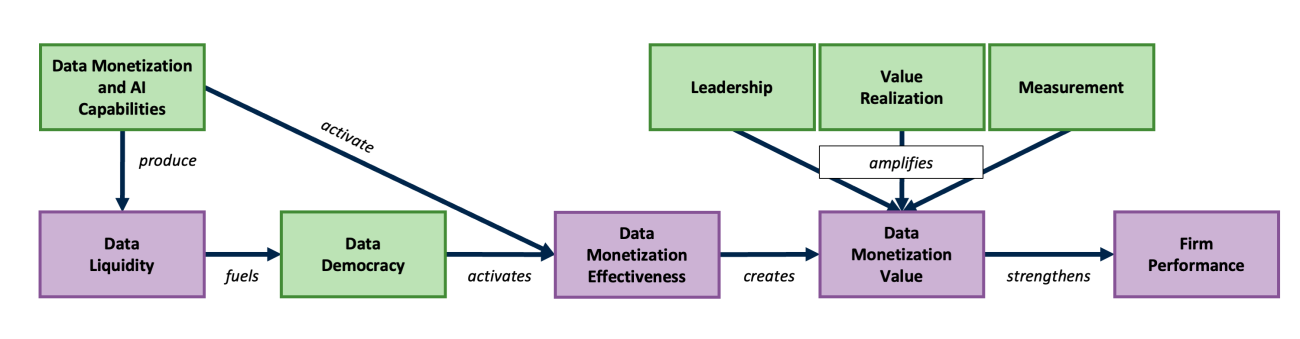
We developed the model in figure 1 to explain the causal chain of how data monetization drives financial performance. We validated the model most recently through a global survey of 349 executives of organizations that spanned a variety of industries, sizes, and geographic regions.[foot]MIT CISR 2024 Data Monetization Survey (N=349). For the full survey report, including the statistical validation of the research model and the performance comparisons reported here, see B. H. Wixom, N. van der Meulen, and C. M. Beath, “Data Monetization: Generating Financial Returns from Data,” MIT CISR Working Paper No. 468, November 2025, https://cisr.mit.edu/publication/MIT_CISRwp468_DataMonetizationSurveyReport_WixomVanderMeulenBeath. [/foot] Across that sample, top-performing organizations attributed 11 percent of their revenues to data monetization, more than five times the 2 percent that bottom performers reported.

Figure 1: The Data Monetization Research Model

Data monetization practices that leaders can influence (shown in green) produce business outcomes (shown in purple).

Figure 1 reads from left to right. An organization builds six capabilities: five for monetizing data—data management, data platform, data science, customer understanding, and acceptable data use; and a sixth, AI explanation, for building trust in AI models. The organization uses these capabilities together to produce liquid data assets, which are designed for reuse and recombination. These assets fuel the organization’s data democracy, a state in which employees have the access, skills, motivation, and guidance to use those assets. With good capabilities and a data democracy, organizations can activate effective data monetization initiatives that improve internal business processes, wrap core products with features and experiences, and sell information offerings to new and existing markets. Effective data monetization initiatives create value in the form of new revenue, lower costs, new business models, and competitive advantage. Three management practices—leadership, value realization, and measurement—amplify how much of that value materializes for the organization. That value, in turn, strengthens firm performance: how the organization fares relative to industry peers on outcomes such as profitability and revenue growth.

We found that Data Board leaders apply this model by modifying their practices in accordance with three principles:

  1. Manage data assets with a product mindset.
  2. Treat data monetization as a team sport.
  3. Realize the value you create.

Manage Data Assets with a Product Mindset

Liquid data assets require upkeep to remain relevant. Therefore, leaders who aim to successfully monetize their organization’s data ensure that data assets are managed as products: owned, maintained, and improved across their lifecycle.[foot]See B. H. Wixom, N. van der Meulen, and C. M. Beath, “Shifting to a Product Mindset for Data,” MIT CISR Research Briefing, Vol. XXV, No. 4, April 2025, https://cisr.mit.edu/publication/2025_0401_DataProductMindset_WixomVanderMeulenBeath.[/foot] Assets managed in this way are reused rather than rebuilt, and their returns compound with each use.

In the Data Board’s experience, data assets built and managed in this manner become the foundation for almost everything else. As one Data Board leader put it, “Our ability to scale AI and build ontologies is dependent on data products; our ability to drive reuse is dependent on data products; our ability to demonstrate understanding of our data (its lineage and metadata) is dependent on data products; our ability to break down silos is dependent on data products.”

Indeed, having a data product mindset has become prevalent among Data Board companies. At one member organization, a portfolio of over 120 data assets managed as products—built on a cloud-native platform with governance, quality, and product management practices—now feeds more than 600 AI initiatives. The organization has won multiple awards for its AI strategy, but the data work came first; the AI results followed.

Do your data assets have owners responsible for reuse and user satisfaction? Read “Shifting to a Product Mindset for Data” to learn how to get started managing your data assets as products.[foot]See Wixom, Van der Meulen, and Beath, “Shifting to a Product Mindset for Data.”[/foot]

Treat Data Monetization as a Team Sport

No organization can monetize its data at scale with just its data team. Rather, it requires that the people who know the organization’s processes, systems, and offerings have the access, skills, motivation, and guidance to use data assets strategically. And it requires shared understanding, with the same words meaning the same things to people across levels and functions.

Yet shared understanding is less common than leaders assume. One Data Board leader wrote a manifesto to get their executive committee to agree on what a data organization was. Years later, a former colleague praised them for being “spot on about data,” and then argued, with conviction, the exact opposite of what the manifesto had posited. Both had used the same terms and assumed they were aligned. The words were shared; the meaning was not.

Shared understanding emerges more quickly if it uses the language the business speaks. At one financial institution, data investments had long been justified in technical terms (infrastructure cost and platform capabilities, for example) that left senior executives cold. Using MIT CISR frameworks, a Data Board leader recast an enterprise risk challenge as a data liquidity problem rather than a data cleanup exercise. They explained to executives that key data existed in an illiquid state, in that it couldn’t flow freely or be trusted across domains. That reframing unlocked executive sponsorship for the development of a canonical data model (an agreed-upon representation of the organization’s core data), an initiative now underway. Such translation is the work of employees who are fluent in both the language of the business and the language of data.

What share of your people actually uses the data assets you’ve built, and how do you know? Read “Mobilize Your Data Democracy” for practices that will raise your organization’s share above the average of 28 percent.[foot]See N. van der Meulen, I. A. Someh, B. H. Wixom, and C. M. Beath, “Mobilize Your Data Democracy,” MIT CISR Research Briefing, Vol. XXV, No. 9, September 2025, https://cisr.mit.edu/publication/2025_0901_DataDemocracy_VanderMeulenSomehWixomBeath.[/foot]

Realize the Value You Create

Data monetization is about solving meaningful problems for customers and internal users alike. Organizations that do it well become great at identifying problems worth pursuing, evolving solutions at pace with shifting needs, driving their solutions’ use, and making sure they see the benefits of use in bottom-line results.

Creating value and realizing value—as in achieving income statement impact—are different. A data initiative that works produces a benefit (such as saved time, an improved process, or a better-served customer), but a benefit is not yet money. A benefit becomes money only when someone acts to make it so, such as by cutting a budget with too much slack or charging the customer for the value a data wrap (a data-driven feature or experience that enhances the value proposition of a product) has added. Organizations frequently forget to go after the money, assuming it will show up on its own.

For the last six years, one Data Board leader has helped their organization build up data assets, AI models, and insights to understand its customers’ customers. They explained, “We had insights that the [customers] themselves did not have. We were, therefore, uniquely placed to help them by sharing our insights with them.” The organization shares what it learns with its customers in a face-to-face “Insight Session.” The session is essentially a data wrap, and the organization charges nothing directly for the insights. If the organization’s customers act on what they learn, those customers’ own sales increase—and they in turn buy more from the organization. “Have we failed to realize value? Far from it!” exclaimed the leader. The organization measures the bottom-line impact of its Insight Session wrap, which has doubled sales to participating customers.

Today, AI has multiplied the ways organizations can fail to create or realize value. Amazing demonstrations or pilots that end in applause and little else simply do not create value. “Productivity shaves” (a few minutes saved on many individual tasks) may thrill individual users, but realizing that value—pushing it to the bottom line—is nearly impossible. A core activity that separates a real return from applause is the practice of measurement: routinely tracing created value to a specific line item on the income statement. One Data Board leader called this discipline the “antidote to AI theater.”

Of the value your data and AI initiatives created last year, how much could be traced back to the income statement? Read “High-Performance Data Monetization” to learn what leading organizations do differently.[foot]See B. H. Wixom, C. M. Beath, and J. Duane, “High-Performance Data Monetization,” MIT CISR Research Briefing, Vol. XXIV, No. 11, November 2024, https://cisr.mit.edu/publication/2024_1101_HighPerformanceDataMonetization_WixomBeathDuane.[/foot]

Building on Evidence

The past decade of our research with MIT CISR’s Data Board produced two things: an in-depth model that depicts our understanding of how data drives financial performance, and the practices that Data Board leaders developed to act on it. The model is the mind, the practices the hand. Real returns happen when both come together, with practice firmly rooted in evidence.

For more than a decade, the Data Board’s leaders and MIT CISR’s researchers have debated, tested, and built together—candidly, and with more interest in getting things right than in being right. The research grew sharper for it, and so did the practice. The Data Board is now bringing its work to a close, and as our shared effort ends, we thank the hundreds of leaders and dozens of researchers who gave it their minds and their hands. Data monetization has become everybody’s business, and they are the ones who showed us how.

© 2026 MIT Center for Information Systems Research, Van der Meulen, Wixom, Beath, and the MIT CISR Data Research Advisory Board. MIT CISR Research Briefings are published monthly to update the center’s member organizations on current research projects.

About the Authors

Profile picture for user cynthia.beath@mccombs.utexas.edu

Cynthia M. Beath, Professor Emerita, University of Texas at Austin and Academic Research Fellow, MIT CISR

MIT CISR Researcher

The MIT CISR Data Research Advisory Board, MIT Center for Information Systems Research (CISR)

MIT CENTER FOR INFORMATION SYSTEMS RESEARCH (CISR)

Founded in 1974 and grounded in MIT's tradition of combining academic knowledge and practical purpose, MIT CISR helps executives meet the challenge of leading increasingly digital and data-driven organizations. We work directly with digital leaders, executives, and boards to develop our insights. Our research is funded by member organizations that support our work and participate in our consortium. 

MIT CISR Patrons
AlixPartners
Avanade
Cognizant
Collibra
IFS
PwC
MIT CISR Sponsors
ABN Group
Alcon Vision
ANZ Banking Group (Australia)
AustralianSuper
Banco Bradesco S.A. (Brazil)
Barclays (UK)
BNP Paribas (France)
Bupa
CalSTRS
Caterpillar, Inc.
Cemex (Mexico)
Cencora
CIBC (Canada)
Commonwealth Superannuation Corp. (Australia)
Cuscal Limited (Australia)
DBS Bank Ltd. (Singapore)
Ericsson (Sweden)
Fidelity Investments
Fomento Economico Mexicano, S.A.B., de C.V.
Genentech
HCF (Australia)
Hunter Water (Australia)
International Motors
JERA Co., Inc. (Japan)
JPMorgan Chase
Kaiser Permanente
Keurig Dr Pepper
Mallesons (Australia)
Mater Private Hospital (Ireland)
National Australia Bank Ltd.
Nomura Holdings, Inc. (Japan)
Nomura Research Institute, Ltd. Systems Consulting Division (Japan)
Novo Nordisk A/S (Denmark)
OCP Group
Pentagon Federal Credit Union
Principal Life Insurance Company
Ralliant
Reserve Bank of Australia
RTX
Saint-Gobain
Scentre Group Limited (Australia)
Schneider Electric Industries SAS (France)
Telstra Limited (Australia)
Terumo Corporation (Japan)
Vanguard
WestRock Company
Xenco Medical
Zoetis Services LLC
Find Us
Center for Information Systems Research
Massachusetts Institute of Technology
Sloan School of Management
One Main Street, E90-9th Floor
Cambridge, MA 02142
617-253-2348