

During our 2026 Annual Research Forum, recent research project findings will be shared by MIT CISR team members Peter Weill, Stephanie Woerner, Ina Sebastian, Alan Thorogood, and Nick van der Meulen plus MIT Sloan professor Roberto Fernandez and other special guests. As always, the event will feature time for audience participation and the peer learning and networking opportunities that make MIT CISR events unique.

In Person
MIT CISR Annual Research Forum 2026
October 14 & 15, 2026 | Cambridge, MA USA
Who should attend the Annual Research Forum?
This two-day event is open to employees of MIT CISR member organizations and a few special guests. Attendance is limited and is managed by our key liaison at each member organization; please contact Chris Foglia if you need information about the key liaison at your organization. Key and alternate liaisons are especially encouraged to attend.
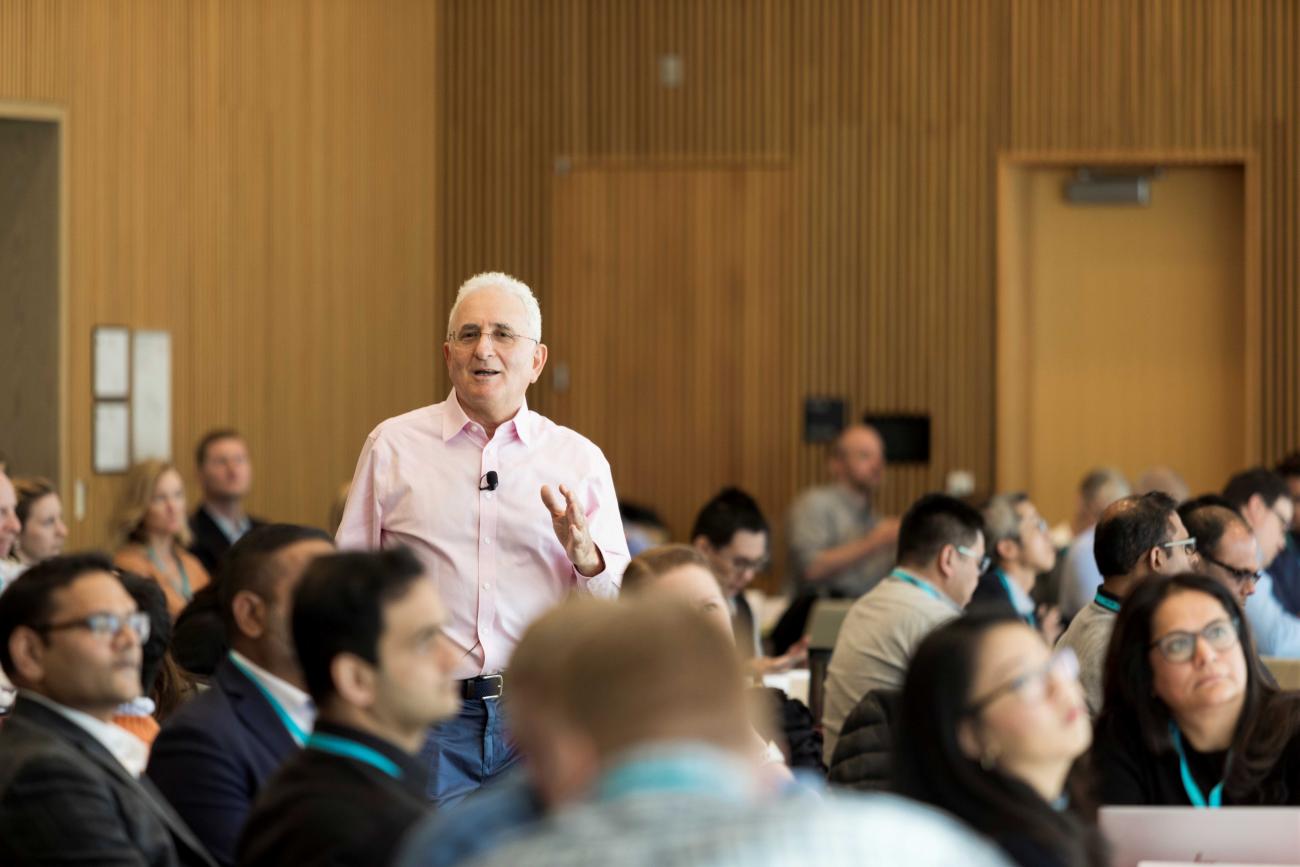
In the adjacent photo, Peter Weill presents during a previous MIT CISR Annual Research Forum.
October 14, 2026
8:15 AM–8:00 PM, US EDT
| 8:15 AM | Check-in and Breakfast |
| 8:45 AM | Introduction |
| 9:00 AM | Developing Expertise for Human-AI Collaboration MIT CISR research has shown that success with AI depends on people knowing when to trust its output—and when to override it. Yet that judgment comes from experience, and the work that once built it is increasingly conducted by AI. In this session, we'll examine the three types of skills that human-AI collaboration demands of your workforce, why most organizations are investing in the wrong ones, and what leaders can do about it. |
| 10:30 AM | Morning Break |
| 11:00 AM | Insights from Behavioral Science: Implications for AI Implementation Roberto Fernandez Adoption of AI is changing the enterprise, including how we work, manage, govern and lead. Research from the behavioral sciences has yielded important insights about the challenges leaders face during times of complexity, volatility and uncertainty. In this session, Roberto will raise awareness of the pitfalls typically encountered in times of change and suggest ways enterprise leaders can navigate the challenges. |
| 12:30 PM | Lunch |
| 1:30 PM | Business Models in the Agentic AI Era This session will also be live-streamed to an online audience. |
| 3:00 PM | Afternoon Break |
| 3:25 PM | Context Is Key: How Establishing Contextual Empathy is Key to New Modular AI Products and Services—A PwC Case Study Building on MIT CISR's Business Models in the AI Era framework, this case study will explore how PwC adopted a Modular Curator business model to transform its regulatory compliance service offering. Gayan will discuss five key insights from PwC’s experience in transitioning from a people-based service offering to an advanced AI-based capability. We’ll explore the value of learning from historical failures and setting thresholds for human intervention and oversight. The discussion will include a technical demonstration and discussion. |
| 4:15 PM | Fifty-two Years of MIT CISR Research: Enduring Challenges and Lessons Learned Peter, Jeanne, and Stephanie will discuss the challenges of doing relevant research for executives plus the enduring lessons that they have learned over MIT CISR's history. Following their conversation, they will open up the discussion to the audience who will share their own experiences and lessons learned. This session will also be live-streamed to an online audience. |
| 4:55 PM | Wrap-up and Feedback |
| 5:00 PM | Networking Reception |
| 6:00 PM | Dinner |
October 15, 2026
8:30 AM–4:30 PM, US EDT
| 8:30 AM | Breakfast |
| 9:00 AM | Establishing Guardrails on the AI Roller Coaster During this session, Alan will examine how enterprises scale AI rapidly by managing risks through visibility, clear accountability, and quick intervention. Architecture compliance, innovation management, workforce roles and skills, and supplier governance are control points, as a case study will illustrate. Alan will conclude with three ways to set up guardrails that enable AI adoption at speed. |
| 10:30 AM | Morning Break |
| 11:00 AM | Senior Executive Interview: Peter Weill and Bradley Fedosoff During this conversation, Peter Weill and Brad Fedosoff, EVP, US Chief Administrative Officer and Technology, Data, and AI (US CAO + TDAI) at CIBC, will discuss how CIBC is integrating AI into the enterprise, fostering effective human–AI collaboration, evolving technology and operating models, and capturing business value while navigating organizational change. |
| 11:45 AM | Lunch |
| 1:00 PM | The AI Decision Matrix: Designing Decision Rights for Humans and AI Companies are beginning to use AI to conduct enterprise work like hiring employees, approving loans, optimizing pricing, and running marketing campaigns. In this session, we will explore a practical framework based on two dimensions, ambiguity and risk, to map decision rights between humans and AI. Using 2026 survey data, studies, and participant experience, we'll examine different approaches to human-AI decision making and implications for accountability, governance, and organizational design. |
| 2:30 PM | Afternoon Break |
| 3:00 PM | Managing Your Digital Colleagues Enterprises are grappling with how to work effectively with AI as it is becoming more embedded in the enterprise, as a role, team member, and tool. This session will examine digital colleagues, which we define as AI that has a role in and performs work, makes decisions and recommendations and interacts with people. Stephanie will present current survey findings and case studies and what it takes to get value from these colleagues. |
| 4:15 PM | Wrap-up and Feedback |
| 4:20 PM | Adjourn |
MIT CENTER FOR INFORMATION SYSTEMS RESEARCH (CISR)
Founded in 1974 and grounded in MIT's tradition of combining academic knowledge and practical purpose, MIT CISR helps executives meet the challenge of leading increasingly digital and data-driven organizations. We work directly with digital leaders, executives, and boards to develop our insights. Our research is funded by member organizations that support our work and participate in our consortium.
AlixPartners
Avanade
Cognizant
Collibra
IFS
PwC
ABN Group
Alcon Vision
ANZ Banking Group (Australia)
AustralianSuper
Banco Bradesco S.A. (Brazil)
Barclays (UK)
BNP Paribas (France)
Bupa
CalSTRS
Caterpillar, Inc.
Cemex (Mexico)
Cencora
CIBC (Canada)
Commonwealth Superannuation Corp. (Australia)
Cuscal Limited (Australia)
DBS Bank Ltd. (Singapore)
Ericsson (Sweden)
Fomento Economico Mexicano, S.A.B., de C.V.
Genentech
HCF (Australia)
Hunter Water (Australia)
International Motors
JERA Co., Inc. (Japan)
JPMorgan Chase
Keurig Dr Pepper
Mallesons (Australia)
Mater Private Hospital (Ireland)
National Australia Bank Ltd.
Nomura Holdings, Inc. (Japan)
Nomura Research Institute, Ltd. Systems Consulting Division (Japan)
Novo Nordisk A/S (Denmark)
OCP Group
Pentagon Federal Credit Union
Principal Life Insurance Company
Ralliant
Reserve Bank of Australia
RTX
Saint-Gobain
Scentre Group Limited (Australia)
Schneider Electric Industries SAS (France)
Telstra Limited (Australia)
Terumo Corporation (Japan)
Vanguard
WestRock Company
Xenco Medical